How Indian Stories and Cultural Experiences Help Children Discover New Interests
Table of Contents
By Samata Dey, Founder of IndiaCafe24
Parents often look for a child's interests in a class timetable: music, dance, cricket, chess or art. Yet the first clue may appear much closer to home. It could be the picture a child keeps returning to in a storybook, the questions they ask a grandparent or the way they watch a potter work at a local fair.
These signs are easy to miss because children rarely announce, "This is my interest." They show it through attention. They linger, repeat a question, try to copy what they have seen or bring the subject up again several days later.
Start with what the child notices
Two children can hear the same story and take away completely different things. In a tale about a king crossing a forest, one may care about the animals, another about the map and a third about how the storyteller changes their voice for each character.
Instead of asking for the moral or a summary, parents can try a few more open questions:
- Which part would you like to see in real life?
- Is there something in the story you would like to draw, build or act out?
- What would you ask one of the characters?
The response gives us a clue, not a verdict. A child who wants to act out every scene might enjoy theatre, but one enjoyable evening does not mean they need to join a class the next morning.
Bring family stories into the conversation
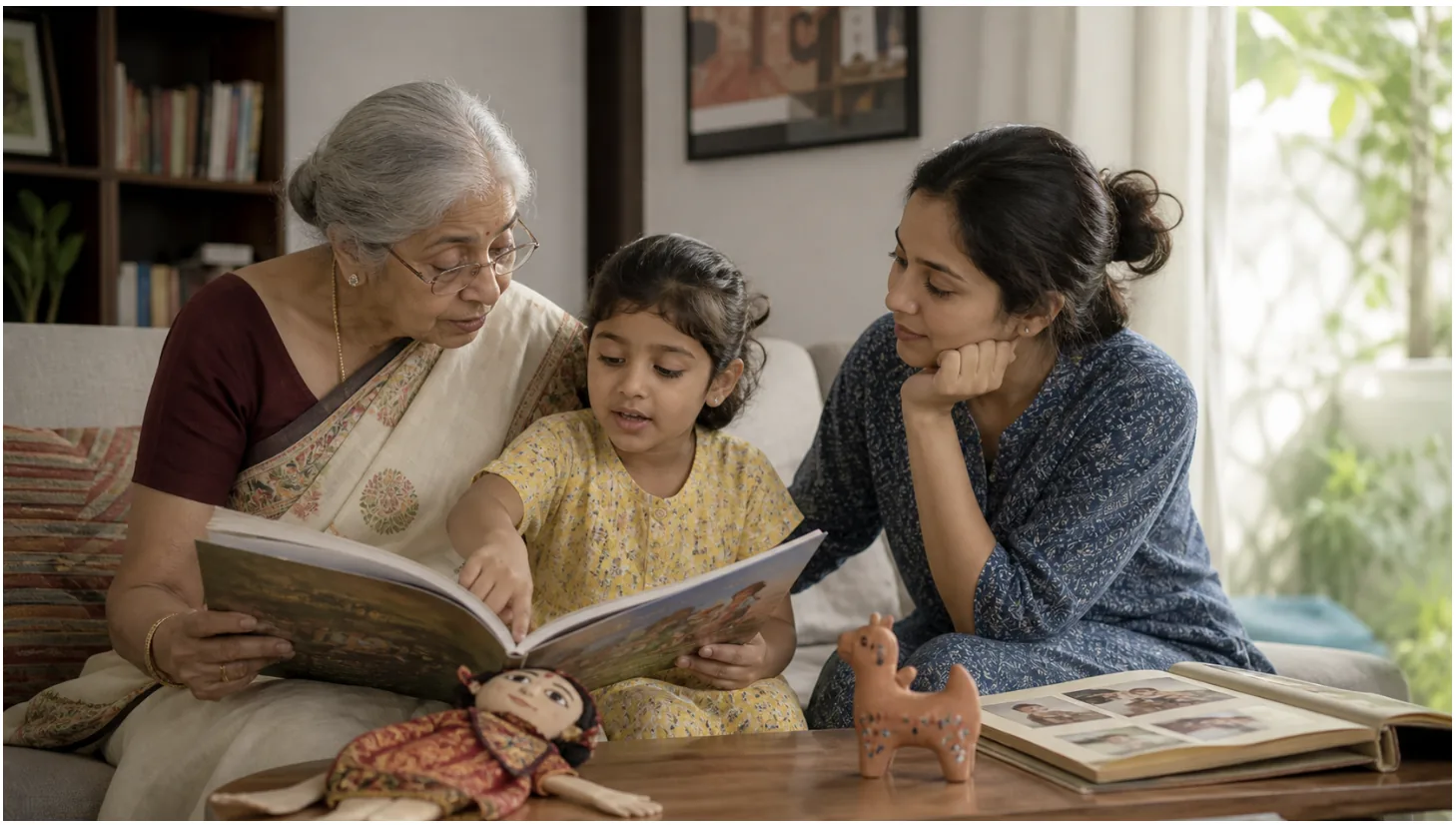
Family stories carry details that children do not always find in textbooks. A grandparent describing a first train journey, a parent remembering games played in the lane, or an aunt explaining how a festival was celebrated in another city can make the past feel real.
Children may notice different parts of the same memory. One may ask about the train, another about the clothes, and another about why the family moved. That follow-up question is useful. It tells the parent where to continue.
The next step can stay simple. Find the old city on a map. Look at a family photograph. Ask another relative for their version. If the child enjoys the story itself, they could record the grandparent, draw a scene or retell it in their own words.
Published stories offer the same starting point. Folk tales, biographies and contemporary Indian children's books can lead towards humour, history, nature, language or illustration. Parents looking for a warm example can begin with this review of Grandma's Bag of Stories and notice which story or character holds the child's attention.
Watch where they pause during an outing
A local outing can make a child's interests easier to see. There is no need to plan an elaborate educational trip. A museum, craft fair, old market, stepwell or nature trail is enough.
Watch where the child slows down without being prompted. At a fort, do they ask about the battle, the stonework or the view from the wall? At a craft fair, do they study the potter's hands or listen to the musicians? On a nature walk, do they collect leaves, follow insects or try to photograph birds?
Parents often plan an outing around what we think the child should enjoy. The part they mention at dinner may tell us more. If they are still talking about the puppet show while everyone else is discussing the food, that is a reason to find another performance or help them make a simple puppet at home.
Look for repetition, not instant talent
A genuine interest does not always appear as talent. A beginner may be clumsy, shy or impatient. What matters first is whether the child returns to the activity willingly.
Suppose a child watches a classical dance performance and tries two steps at home. That is curiosity. If they ask to watch it again, recognise the music later and keep practising on their own, the signal is stronger. The same applies to sketching, chess, gardening, storytelling or cricket.
Parents can keep a light mental record:
- Does the child bring it up again without a reminder?
- Do they enjoy doing it, not just buying the equipment?
- Are they curious enough to keep going when the first attempt is difficult?
This is more useful than asking whether they are "good at it" on day one.
Offer the smallest sensible next step
Once an interest repeats, give it a little more room. Borrow another book, attend a public performance, try a short home project or book one trial class. A small step lets the child explore without feeling that a casual curiosity has become a new obligation.
It also saves parents from rushing into fees, equipment and a packed weekly schedule. If the child continues to ask for more, the family has a better basis for choosing a teacher or programme.
Children's interests will change, and that is normal. A month spent exploring pottery is not wasted because the child later prefers music. They have still learnt how clay behaves, how something is made by hand and what they do or do not enjoy.
Stories and cultural experiences offer many doors without forcing a child through any one of them. The parent's job is to notice where the child pauses, make the next step possible and leave enough space for the interest to grow or change.
About the author
Samata Dey is the founder of IndiaCafe24, an online portal covering books, culture, lifestyle and conversations with authors and creators. She is also a compiler and editor of anthologies.