How Parents Can Support a Child Who Is Starting Cricket
Table of Contents
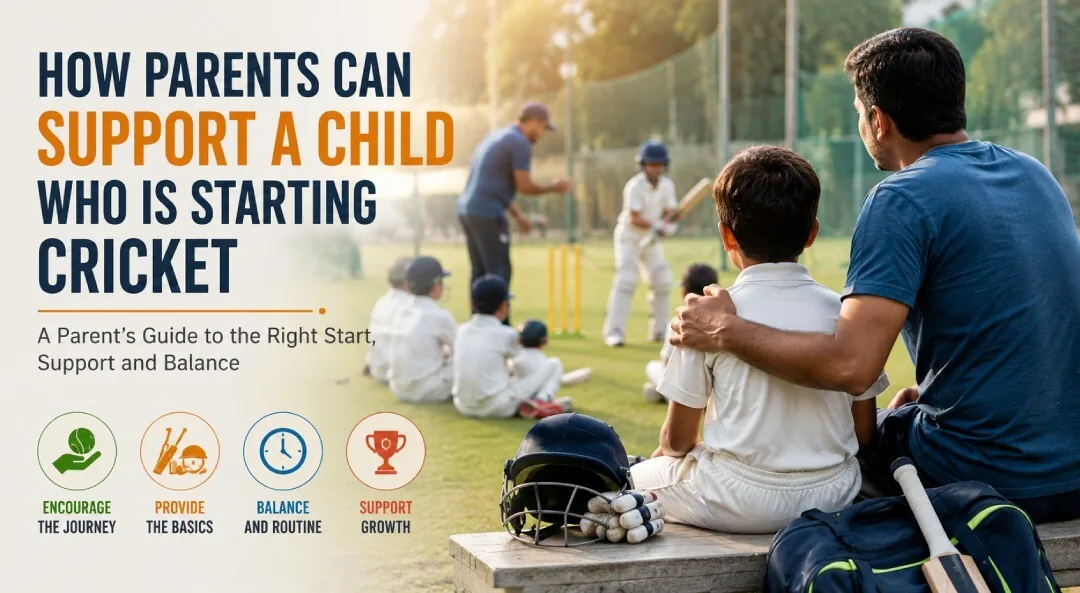
Starting cricket can be an exciting experience for a child. The first cricket bat, the first coaching session, the first clean catch and even the first match can become memories that stay with them for years.
For parents, however, the early stages can raise plenty of questions. How often should a child practise? What equipment do they actually need? Should parents arrange extra net sessions? When should a child start playing competitive cricket? And how can parents encourage improvement without making cricket feel like another school assignment?
The most important thing to remember is that a young cricketer does not need to become highly competitive immediately. The first goal should be to develop basic skills, confidence, enjoyment and a healthy relationship with the game.
Good junior cricket programmes generally focus on fundamental skills such as batting, bowling, catching, throwing, teamwork and understanding how the game works. For example, the England and Wales Cricket Board's junior programmes use age-appropriate equipment and activities while encouraging parents to be involved positively.
This guide explains what parents can realistically expect when their child starts cricket and how to provide the right support without putting unnecessary pressure on them.
What Should Parents Expect During the First Few Months?
The first few months of cricket training are primarily about learning and adaptation, not performance.
A beginner may initially struggle to:
- Hold the bat correctly
- Judge the bounce of the ball
- Catch consistently
- Bowl in a straight line
- Remember basic rules
- Run between the wickets confidently
- Concentrate throughout an entire session
That is completely normal.
A child may hit the ball beautifully one day and struggle to make contact the next. They might take three catches in practice and drop an easy one during a match. These fluctuations are part of learning a new sport.
Parents should therefore avoid judging progress only by runs, wickets or match results. Instead, look for smaller improvements:
- Is the child more comfortable holding the bat?
- Are they beginning to understand where to stand?
- Are they communicating with teammates?
- Are they enjoying practice more?
- Are they becoming willing to try skills that previously frightened them?
These are meaningful signs of development.
Progress Is Rarely a Straight Line
Young players develop at different speeds. One child may naturally coordinate their hands and eyes quickly, while another may need several weeks before catching becomes comfortable.
Physical growth also changes coordination. A child who suddenly becomes taller may temporarily look less balanced because their body has changed faster than their movement patterns have adapted.
That is why comparing your child with another player at the academy can be misleading. The better comparison is with their own performance a few weeks earlier.
What Should a Beginner Child Learn First?
Parents sometimes expect cricket coaching to begin with advanced batting techniques, bowling variations or intensive fitness work. For most beginners, the foundation is much simpler. A good early programme should gradually introduce:
Batting
- Comfortable grip
- Balanced stance
- Watching the ball
- Basic defensive shots
- Simple front-foot and back-foot movements
- Running between wickets
Bowling
- Safe throwing and bowling action
- Basic run-up
- Release point
- Direction and control
- Following through safely
Fielding
- Catching technique
- Ground fielding
- Throwing
- Backing up
- Understanding basic field positions
Game Awareness
- Basic rules
- Scoring
- Taking wickets
- Team communication
- Sportsmanship
The objective is to create a player who understands the game and enjoys participating in it.
What Cricket Equipment Does a Child Actually Need?
Parents do not necessarily need to purchase an expensive professional cricket kit on the first day. The equipment required depends on the child's age, playing level and whether they are playing with a soft ball, tennis ball or leather cricket ball.
For a beginner, the essentials may include:
- Cricket bat appropriate for the child's size
- Batting gloves
- Helmet when required
- Cricket shoes suitable for the playing surface
- Comfortable cricket clothing
- Protective equipment appropriate to the age and level
- Water bottle
- Cricket bag
If the child is still learning with softer equipment, some protective requirements may differ from those needed for hard-ball cricket.
The most important consideration is fit and suitability, not simply buying the most expensive equipment. A bat that is too heavy can make it difficult for a young player to control the swing. Similarly, poorly fitting protective equipment can be uncomfortable and may discourage a child from wearing it correctly.
CricketBio's guide on Cricket Bat Size by Player Height and Age can also help parents understand why bat selection should consider the child's size and ability rather than age alone.
How Often Should a Child Practise Cricket?
There is no single practice schedule that works for every child. A six-year-old beginner and a 14-year-old player preparing for school competitions have very different physical and developmental needs. For beginners, quality and enjoyment are generally more important than adding more training hours.
A practical starting point might be:
| Stage | Possible Training Approach |
|---|---|
| Complete beginner | 1–2 structured sessions per week |
| Developing player | 2–3 sessions per week depending on age and schedule |
| School/club player | Coaching plus age-appropriate matches and recovery |
| Competitive junior | Structured training based on the player's coach, workload and competition schedule |
These are starting points, not medical or coaching prescriptions. Parents should consider the child's age, school workload, other sports, sleep, physical condition and the coach's assessment.
Don't Turn Every Day Into Cricket Day
More practice does not automatically mean faster improvement. Young athletes need time to recover physically and mentally. The American Academy of Pediatrics recommends that young athletes have at least one to two days away from competition and sport-specific training each week, while sports-medicine guidance also emphasizes monitoring fatigue, sleep, mood and performance.
The goal is to develop a child who wants to keep playing cricket for years — not one who becomes exhausted by it within a few seasons.
Avoid Early Overtraining
One of the biggest mistakes parents can make is assuming that a talented child needs to train constantly. A child who enjoys cricket may ask to practise every day, and enthusiasm is wonderful. But parents should still watch the overall workload.
Warning signs that a child may need more recovery include:
- Persistent tiredness
- Repeated complaints of pain
- Poor sleep
- Drop in school performance
- Losing enthusiasm for practice
- Irritability
- Declining sporting performance
- Reluctance to attend training
Overuse injuries and burnout are recognised concerns in young athletes. The American Academy of Pediatrics recommends age-appropriate training, regular rest and attention to physical and psychological recovery. If a child has persistent pain or other health concerns, parents should speak with an appropriately qualified healthcare professional rather than simply increasing or changing training.
Balancing School, Cricket and Rest
For most children, cricket should fit into life rather than completely control it. A simple weekly schedule can help. For example:
- Monday: School + rest
- Tuesday: Cricket training
- Wednesday: School + free play
- Thursday: Cricket training
- Friday: Homework + rest
- Saturday: Match or cricket practice
- Sunday: Family time, recovery or another activity
The exact schedule will vary, but the principle is important: school, sleep, family time, friendships and unstructured play should not disappear because a child has started cricket.
A young cricketer also benefits from doing activities outside cricket. Running, swimming, cycling, football and other age-appropriate sports can develop general athletic ability while keeping physical activity enjoyable.
What Role Should Parents Play During Training?
Parents are extremely important in junior sport, but their role is different from the coach's role. A coach should handle technical instruction. Parents can provide:
- Encouragement
- Transport
- Equipment
- Healthy routines
- Emotional support
- Help with scheduling
- A positive environment
You do not need to correct every technical mistake your child makes. If the coach says the player's grip needs changing, let the coach teach the correction. At home, your role can simply be to encourage the child to practise and enjoy learning.
Ask Better Questions After Practice
Instead of asking "How many runs did you score?", try:
- "What did you enjoy today?"
- "What did you learn?"
- "What was difficult?"
- "Was there anything you want to practise next time?"
These questions shift attention from results to development.
Don't Compare Your Child With Other Players
This is particularly important in junior cricket. One player may score heavily at age nine and then progress normally afterward. Another may appear average at nine but make significant progress at 12 or 13. Growth, coordination, confidence, coaching, opportunities and maturity all influence development.
Statements such as "Why can't you bat like him?" can easily turn healthy competition into anxiety. Instead, compare your child's current skills with their own previous performance. A much healthier conversation is: "Last month you struggled to catch those high balls. Today you caught three. That's good progress." That teaches the child to value improvement.
How Parents Can Keep a Child Motivated
Motivation should ideally come from the child — not solely from the parent's expectations. Children can lose interest when every practice session becomes a discussion about selection, runs or future careers.
Keep some cricket activities purely for fun. Play in the garden. Throw a few balls. Watch a match together. Let the child choose whether they want to bat, bowl or field during casual play. Even structured junior programmes often emphasize making cricket fun and inclusive because enjoyment is an important part of keeping children involved in sport.
Praise the Process
Instead of only praising "You scored 50!", also praise:
- "You stayed patient after those first few difficult overs."
- "You kept trying after dropping that catch."
- "Your running between the wickets was much better today."
This teaches children that effort, discipline and learning matter — not just the final score.
When Should a Child Start Playing Competitive Cricket?
There is no universal age at which every child should begin competitive cricket. The right time depends on age, interest, skill level, emotional readiness, physical development, understanding of the game, quality of coaching and availability of suitable competitions.
A child does not need to be technically perfect before playing a match. In fact, appropriately structured games can help children learn skills that are difficult to reproduce in drills. They learn how to handle pressure, communicate, make decisions, respond to mistakes, understand field placements, bat against unfamiliar bowlers, bowl when the result matters and work as part of a team.
The key word is age-appropriate. Competition should challenge a child without making them feel that every match determines whether they are a good cricketer.
Signs Your Child May Be Ready for Competitive Cricket
- They understand basic rules. They know what constitutes a run, wicket, boundary and legal delivery at the level they are playing.
- They can follow simple instructions. They can respond to basic coaching during a game.
- They enjoy playing against others. The child shows curiosity or excitement about matches rather than only wanting to practise privately.
- They can handle small failures. Getting out or dropping a catch doesn't cause them to completely lose interest in the game.
- They understand teamwork. They can field, communicate and support teammates even when they aren't personally performing well.
- They want to compete. This may be the most important factor. If the child repeatedly asks to play matches, that interest should be taken seriously.
What If the Child Is Not Interested in Competition?
That's perfectly fine. Some children enjoy cricket mainly as recreation. Others become competitive later. Parents should avoid assuming that every child who attends an academy needs to pursue district, state or professional cricket.
A healthy sporting experience can provide benefits even if the child never plays representative cricket. They can develop fitness, coordination, discipline, teamwork, confidence, communication and resilience. The value of cricket isn't measured only by trophies.
Choosing the Right Cricket Academy
The quality of the coaching environment matters more than simply choosing the academy with the biggest reputation. Parents should ask:
- Who coaches the children regularly?
- How many players are in each group?
- Is the training age-appropriate?
- How are workloads managed?
- What happens if a child is injured?
- Does the academy provide match opportunities?
- How does the coach communicate with parents?
- Are facilities safe?
- Is there a clear safeguarding policy?
It can also be useful to watch an actual training session before committing. A good academy should be able to explain what the child is currently learning and what the next stage of development looks like. Be cautious about academies that promise guaranteed selection or professional careers. No legitimate coach can guarantee that a young player will become a professional cricketer.
What Parents Should Avoid
There are several common mistakes that can unintentionally make cricket stressful.
- Don't make every conversation about performance. Your child should be able to talk to you about cricket without feeling that they are reporting a performance review.
- Don't give constant technical instructions. Too many instructions can create confusion, especially when they contradict what the coach has taught.
- Don't criticise after every dismissal. Getting out is part of batting. Help the child understand what happened rather than treating the dismissal as a failure.
- Don't force extra training. If the child is physically or mentally tired, another net session may not be productive.
- Don't compare selection results. Another player being selected does not automatically mean your child is behind. Development is individual.
A Simple Parent Checklist
Before and during your child's cricket journey, ask yourself:
- Is my child enjoying cricket?
- Is the coaching environment safe and respectful?
- Is training appropriate for their age and ability?
- Are they getting enough sleep and recovery?
- Is schoolwork being managed?
- Are they developing skills rather than only chasing results?
- Does the child still have time for friends and other activities?
- Are injuries or persistent pain being taken seriously?
- Does the child want to play competitive cricket?
- Am I supporting rather than controlling their cricket journey?
If most of these answers are positive, you're probably providing the kind of support a young cricketer needs.
Final Thoughts
Starting cricket is about much more than learning how to hit a ball or bowl a delivery. For a child, the early months are an opportunity to discover a sport, make friends, develop physical skills and learn how to deal with both success and failure.
Parents have an important role, but that role is not to become a second coach. It is to create the conditions in which the child can learn, recover, enjoy the game and gradually decide how far they want to take their cricket.
Give them the right equipment. Find a safe and suitable coaching environment. Protect time for school and rest. Encourage practice without demanding constant improvement. Most importantly, allow the child to enjoy the game.
If a competitive pathway becomes appropriate later, the child will be better prepared — not only because of their cricket skills, but because they have developed confidence, resilience and a genuine love for the sport. The best thing a parent can give a young cricketer is not pressure to become the next star. It is the freedom, support and opportunity to enjoy becoming the best version of themselves.
About CricketBio
CricketBio is a cricket-focused resource covering practical guides, batting and bowling techniques, cricket rules, equipment advice, training tips and information for players at different stages of their cricket journey. Parents and young players can explore the CricketBio cricket blog for more practical cricket resources and beginner-friendly guides.